
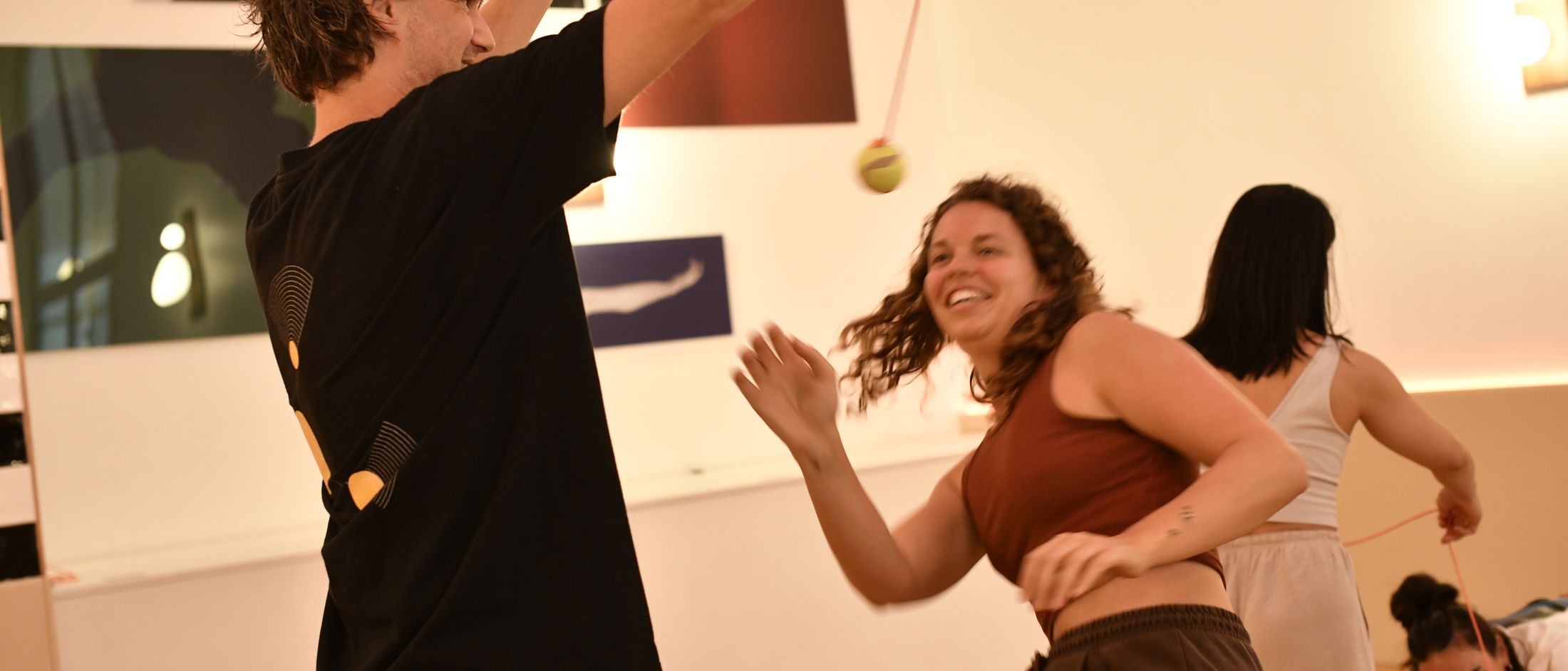
Three scientists, one psychotherapist and a full studio. The first MVMT Talks asked what movement really does for the brain, and got answers that were sharper, funnier and more useful than the wellness headlines.
In Lisbon, the studio floor at MVMT Studio was cleared for something new. MVMT Talks is our new event series, bringing together people who think hard about movement, well-being and health, and putting them in a room with our community.
For the first edition, founder Max Rodman brought together a panel that would be hard to assemble anywhere:
- Dr John Krakauer, neurologist and neuroscientist, Johns Hopkins professor and director of the Centre for Restorative Neurotechnology at Champalimaud, Lisbon
- Dr Rajita Sinha, Yale professor of psychiatry and neuroscience and director of the Yale Interdisciplinary Stress Center
- Dr Joseph Guarnaccia, neurologist specialising in multiple sclerosis since 1994
- Moderated by Jeff Krone, a Lisbon-based somatic psychotherapist and MVMT member
Over 98 minutes they covered neuroplasticity, psychedelics, stroke recovery, stress, interoception and the wellness industry. Here is what stayed with us.
Neuroplasticity is real. Most of what you hear about it isn’t.
Jeff opened with the word everyone uses: plasticity. John didn’t hold back. “It’s one of the most irritating notions imaginable,” he said. “Most people who say it have no idea what they’re talking about.”
His point was not that the brain doesn’t change. It does, every time you learn a language or a sport. What he objects to is the magic around it. “The brain is rewiring, the brain is remapping … one area of the brain is taking over from another. It’s all nonsense.” The good news is that the ordinary kind of plasticity “can get you a long way” through exercise, training and rehab. It just has to be practised.
Rajita agreed and put her psychologist’s hat on: plasticity is really another word for learning. A single dose of anything, she said, won’t change how you live day to day. “There’s a lot more that goes into it.”
Thinking and moving together beat either alone
John described a study in which healthy adults did one of three things: brain games, treadmill running or wrestling. On purely cognitive tests, wrestling won. “This mixture of thinking and moving seems to have a multiplicative effect,” he said. “There’s something magical about the combination.”
It is also the idea behind his work in stroke rehabilitation: open a window for change, then train hard inside it. Reopen the window and skip the training, and “you waste it”.
Stress you ignore doesn’t go away
Rajita brought the evening to the audience. She asked the room how they know they’re stressed, and the answers came fast: tension, a racing heart, insomnia, a racing mind. Those signals are interoception, the body reporting to the brain.
Chronic stress, she explained, teaches us to silence them. When an audience member said their instinct was to park it and get things done, Rajita didn’t tell her to stop. She offered a simple tool instead, STOP: Stop or slow down, Take a breath, Observe what’s happening in your body, feelings and thoughts, and Proceed towards your goal. “Your body has still felt it and knows what happened,” she said. “Noticing it is going to get you back in control of it.”
The panel’s prescriptions
Asked to prescribe one form of movement to everyone in the room, nobody could pick just one.
- John: a racket sport, dancing (“preferably disco dancing”) and reading hard books. Anything that combines socialising, skill, cognition and exercise, for an hour or two, three to four times a week.
- Rajita: yoga that brings breath, body and attention together, plus dancing. Start with five-minute blocks and build from there.
- Joe: walking uphill. As John pointed out, Lisbon is good for you because there are hills.
The old-fashioned things still win
The sharpest moment came from a question about fascia. John widened it into a warning about the wellness industry’s latest gadgets and supplements. “The things that work and have the best evidence are the old-fashioned, analogue, simple things,” he said. “Sleep well, eat well, have friends, read books and exercise.”
Rajita added the human caveat: stress is exactly what knocks those basics over first. “I call them the goalposts for health and well-being,” she said, and “stress will knock those things down”.
Read the whole conversation
This write-up is the short version. The full 98 minutes are published in full, lightly edited for readability: read the complete transcript.
What’s next
Thank you to John, Rajita, Joe and Jeff, and to everyone who came and asked such good questions. This was the first of many MVMT Talks.